|
INTERVIEW
Date: September 14, 2000; rev 1- 6 Oct 2000, rev 2- 20
Aug 2001, rev-3- 29 Nov 2001.
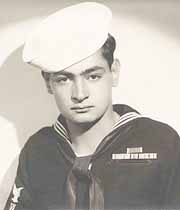 Ex-POW: Ex-POW:
Bruce Gordon Elliott; DOB: 18 May 1923
Interview By: Roger Mansell, Palo
Alto CA, Assoc Editor, Tameme Literary Magazine
A few blocks from the busy 405 Freeway, one can find the home of Bruce
Gordon Elliott. Twelve days shy of his 19th birthday, his life was
changed forever. He was captured by the Japanese on Corregidor, the
impregnable fort protecting Manila from any attack.
This is the story of a young man who escaped from a Japanese slave
labor detail, assigned to hand build a runway at Puerto Princesa, on
the island of Palawan. Three months after capture, Elliott and 5 fellow
American soldiers escaped from this living hell. 150 men of this detail
were massacred by the Japanese before the war ended, a war crime that
has faded from public knowledge.
The six men who escaped were:
Davis, C.D., Pfc, USMC, 4th Marines (*)
Elliott, B.G., S1c, USN, USS Bittern (**)
Henderson, B., Pvt., USMC, 4th Marines
Hodges, K.M., S1c, USNR, USS Genessee
Kelland, R.W., S1c, USN, 16th Naval District
Wright, S.T., Pvt, USMC, 4th Marines
(*) listed as Pvt in records (**) Listed as D. Elliott, Y3c in records
5 May 1942
At 10:30 PM that night, the Japs started to land troops on Corregidor's
Monkey Point, the side facing Bataan. We were dug in with our 50 cal.
Machine Gun on the far side (defiladed) and did not fire in that
action. The firing of guns, mortars, and grenades was intense and the
Japs were driven off, probably most of them killed.
Around 2:30 in the morning, they came back again, landing 3 barges
right in front of me. I held fire until their ramps started to drop...
opening fire at less than 20 yards, sweeping into the interiors of
each. With just the one gun, two boxes of ammunition, and six grenades,
the slaughter in front of our position was almost total. The ten of us
had Springfield rifles (306) and six hand grenades.
On the reverse side, however, the Japs landed two light tanks. We did
not have a single anti-tank weapon so our fate was inevitable. By noon,
the word had come that we were to surrender... destroy your weapons and
stand down... and wait.
*
For me, the war began about noon, Wednesday, 10 Dec 1941 [Other side of
dateline from Pearl Harbor] I knew full well the war had started by
seeing the bombing of Manila. I had only heard rumors of other Jap
attacks and landings. High overhead, a flight of Jap bombers, coming
from the direction of Manila, passed overhead toward the sea. A few
minutes later, they wheeled around, headed toward Cavite Navy Yard...
and me. Three waves of bombers with 57 planes in each wave, dropped
stick after stick of bombs, plastering the entire base. With fighter
escorts, the Japanese bombers never deviated from their course.
I had been on my way to the canteen to buy a beer, and was passing the
baseball field near the main gate. I saw 4 large coils of wire, each
about four feet high, sitting on the edge of the field. I believe this
was wire for making anti-submarine nets to string in the harbor. Around
the two foot core, the coiled wire was at least a foot thick. I jumped
inside one of the coils. It was my dugout above ground with a perfect
view of the attack.
Anti-aircraft flak burst harmlessly, thousands of feet below the Jap
Betty Bombers and I saw no American fighters rose to stem the attack.
Small black objects, like tiny specs, began to tumble from the planes.
"Sticks" of bombs were headed my way. I jumped inside one of the coils,
my head below the top. Bombs dropped everywhere as more than 50 bombers
disgorged their deadly cargo.
The yard was flattened, buildings burning everywhere--the sounds of the
wounded echoing across the base. Burning fuel tanks threw up flames,
the plumes of black tumbling across the yard toward Manila. It was a
fire that was to last a week. I was safe, the coils having deflected
any shrapnel. I ran to my ship, the USS Bittern,
(1) burning alongside the pier. Men were wounded but still
fighting the fires. In minutes, the fires were extinguished and the
wounded bandaged, ready for evacuation. I clamored over the Sea
Lion, jumped ashore with another Boson's Mate, 2nd Class,
and reported for duty aboard the other mine laying ship, the USS
Tanager, AM-5.
(2)
Meanwhile, the submarine rescue vessel, the USS
Pigeon, ASR-6,
(3) towed the Bittern, towing her from
the burning pier. Some of us used fire axes to cut our mooring lines
that were tied to the Sea Lion. With the critical
engine parts ashore being repaired now destroyed, the Bittern could not
move on her own. As with the USS Canopus, she was towed up to Marveles
Bay on Bataan, eventually being scuttled before the surrender of Bataan.
Aboard the Tanager, the only duty was to go out
at night, sweeping the channels for mines. During the day, the would
tie up and leave the ship. Without air defense, the Tanager
became an "LST", a large sitting target for the Jap planes, unmolested
as they strafed and bombed at will. With the declaration of Manila as
an "Open City," the Tanager anchored at
Corregidor, finally sinking on 4 May.
Not needing a full crew, I was released from the Tanager
in late March with orders to report to an Army Captain on Corregidor.
From Corregidor, I was taken to Marveles, loaded on a truck to Cabcaben
Point and instructed to be "a look out" for Japs. If I saw any, I was
to report immediately. Food and water was to be brought to me twice a
day. If available, the usual food by now was simply rice and some
canned salmon. It was scary as hell-- alone, just about to turn 19--and
Japs on the way.
Some 10 days later, the Captain came back and said, 'The Japs are
coming this way. Want to go back to Marveles?" I knew that Bataan would
be over run by the Japanese. I felt sure that I would be safe on
Corregidor as the Japs could never take that fortress.
"No way" I declared. That same afternoon I began swimming toward
Corregidor. As the sun set, I was still swimming, the tides pushing me
out to sea. After six hours of nonstop swimming, I felt sure I was
going to drown any minute when a Navy launch picked me out of the sea.
Dressed only in skivvies, I was taken to Queens Tunnel and given new
clothes.
With nine other men, I was assigned to a machine gun nest at Monkey
Point, facing away from Bataan. With the fall of Bataan on 9 April, the
shelling of Corregidor began in earnest. Dug in as we were, unless a
shell hit you directly, one's chances of survival were quite high.
Waiting in Queens Tunnel, we were surrendered at noon. The Jap Marines
(4) were big men, apparently selected for their size and
strength. One single Jap soldier came into the tunnel, never said a
word, and proceeded directly to the water spigot and filled his
canteen. Really quite brave. He departed and shortly, another one of
these Japs came into the tunnel and, with much screaming, shouting,
bayonet prods, and sign languages, formed us into four ranks along the
road, a cliff dropping about 100 feet to the rocky shore below. The
Japs made it clear we were to strip naked, piling our clothes into
separate piles of shoes, socks, pants, shirts, and hats. With sharpened
bayonets, the Japs went down the rows, clipping off dog tags.
Naked as a jay birds, the first rank was told to move to the cliff's
edge, the Japs seemingly demanding they jump to their death. The
Bushido Code of "death before the dishonor of surrender" was apparently
to be imposed upon the American prisoners. The men froze in place.
Being in the fourth rank, I was terrified.
Suddenly, two Jap officers came around the curve, screaming orders to
the now subservient soldiers. Apparently, the Jap soldiers had not
known of the surrender and were determined to rid themselves of these
"vile Western cowards." With alacrity, we grabbed whatever clothes we
could, dressed to avoid the sun, and were placed on labor details on
Middle Side, hauling captured guns to the wharf.
At the 92nd garage area, we were all forced to sit on the hot pavement,
little food and almost no water. Other than being sent on work details,
we all remained there for another 10 days. The worst detail was
gathering up the dead. There was blood, bodies, and body parts
everywhere. We dragged the Jap bodies, bloated from the heat, into huge
piles, five to six feet high and twenty feet in diameter. Gasoline was
poured on and the bodies cremated. The fires would burn for a few days,
the fat of the bodies acting as fuel. When the fires stopped, a special
group of Japs came by, gathering bits of bone and ash into small boxes,
approximately 2 x 2 x 4. These were sent to the family of the dead,
apparently symbolic of the sacrifice their children made for the
Emperor.
At the 92nd Garage area, water was available from only one small line.
To fill one cup meant waiting in line, often as long as 24 hours. The
Assault marines departed the first day after surrender, being replaced
by much less disciplined and vicious soldiers. One could easily discern
the difference as this low class thugs took over guarding the prisoners.
At the 92nd, almost 12,000
(5) of us were packed into an area not much larger than a
football field. There was no shelter from the boiling sun as we sat on
the cement parking lot. I had managed to retain a tent shelter half and
I shared it with three other sailors, including S1c Yoder. Yoder was
what is called a "great dog robber;" able to get supplies, food and
water for us. To put it simply, he was a great thief. I was unable to
move too freely having 12 pieces of shrapnel in my foot. Yoder managed
to get us water, large cans of corned beef and peaches plus cans of
condensed milk. As the Japanese did not care if we ate at all, food was
precious and water was life itself. By the time we left the 92nd garage
area, we were extremely weak.
(6)
On Saturday. 23 May, we were packed aboard a small freighter, jammed in
so tight that no one could sit down. After an all night wait, we cast
off for Manila. As we approached Manila, the ship stopped just offshore
from the Santa Anna Racetrack. Barges were brought alongside and we
climbed down. As we grounded, the men were forced to jump into the
water, swimming and struggling to get ashore. Some of the short guys
would have drowned if not held up by their buddies. Filthy, sweaty and
wet, we were lined up in groups of 100 men, columns of four, and
marched through the city to Bilibid Prison. The Japs intended to
humiliate us in front of the Filipinos but you could see they were
sympathetic to our suffering.
Two weeks later, we were marched to the train station and jammed into
railway freight cars. Small, dirty, rusting metal walls, they were
ovens in the sun. Again, the Japs crammed us in with standing room
only. Despite shoving by the guards, I managed to stand near the door
and was able to get some fresh air. Some of the men in the corners were
suffocating and passing out from the heat.
After a few hours waiting in the sun, the train began to move. For
hours, we rattled on north, arriving at the railhead in Cabanatuan that
evening. Marched a short distance, we waited overnight in the local
schoolyard. I managed to get space under the school house and dropped
off to sleep. At dawn, we were roused, counted again and again and
began an all day march to Camp #3. With no food for breakfast, the sun
beat down on us as we headed northeast. Each time we stopped, we were
forced to remain in the sun rather than in shaded areas. The tropical
sun, flies and dust took a deadly toll on the men, the column spreading
out and men falling by the wayside.
We passed Cabanatuan # 1, another empty camp (Cabantuan #2), finally
arriving at our camp in the mid afternoon, 26 May 1942.
(7)
I witnessed the murder by the Japanese of four men charged with
"escaping."
(8) For a few days, they were forced to straddle a large
pole, their hands drawn down and tied underneath. Day and night, they
were kept there as the sun burned their exposed skin, mosquitoes and
flies swarming everywhere. On the third or fourth day, much of the
entire camp watched as the men were cut loose and forced to dig a
trench. It was obvious as the men stood in the trench that a firing
squad was about to execute them.
The Japs announced that the men had tried to escape and were now to be
executed. One of the intended victims spit on the officer.
(9) The firing squad shot them down. The man who spat
struggled back up but was shot again, crumpling into the ditch. As
officer stepped forward and put a bullet into the head of each man.
(10)
The Japs, to thwart further escapes, announced that the men would be
placed in groups of ten. If one escaped, the others would be executed.
It was an effective method. In the entire war, fewer than 25 men made
escapes to freedom.
At Cabanatuan #3, I lived with 135 men in an Atap barracks, fed a cup
of watery soup and a small hand full of rice, three times a day. I told
the Japs that I was a Yeoman, hoping to get a detail where I could get
some extra food.
At the end of July, the Japs selected 300 of the "fittest men," sending
us again in boxcars back to Bilibid. The next day, we began loading a
freighter at Pier 6 with salt, rice, wheelbarrows, pickaxes and other
tolls for three to four days. We 300 were the last "cargo" to be loaded.
Halfway to Palawan, the shipped dropped anchor at the island of Culion,
an island north of Palawan. I had found a twenty foot length of rope in
the hold and coiled it around my body, beneath my shirt. I thought I
could slip over the side and escape during this stay. We began
unloading supplies and I realized the island was the site of Culion, a
leper colony. I canceled my escape plans.
At Puerto Princesa, it was obvious they were starting to build an
airstrip. One first jobs were to pull weeds, gather them in piles, load
wheelbarrows and dump the weeds over the cliff. A wheelbarrow "slipped"
from my hand, plummeting over the edge. The Japs beat the living hell
out of me for that stunt.
Yoder spotted some peppers growing where we were pulling weeds. He knew
that variety was extremely hot, too hot to eat as they would literally
burn your mouth. Spotting a guard looking at him, he picked some of the
peppers, faked lifting them into his mouth, pretending they were
delicious. The grinning Jap guard shoved Yoda aside, grabbed a hand
full and shoved them into his own mouth. With eyes bulging, he screamed
for water as we rapidly disappeared.
Our barracks were formerly used by the island's constabulary. I noted
that the local impressed laborers had a twelve foot pole to scale the
wall, apparently for sneaking out at night to spend time with their
families. That evening, in a very heavy rain, I used the pole to climb
to the top, pulled the pole up after myself and lowered myself down the
other side. Fleeing into the church, I located the local priest and
said I was escaping.
The priest gave me a small map of the Philippines, a compass and an
alarm clock. I climbed back into the barracks, asking others to join
me. A young Lieutenant said, "No way you'll make it" Chief Fox said,
"I'm too old to try."
(11) At first, seven said yes but when it came time to flee,
only five men agreed to come with me. At 10:30 P.M., 10 August 1942, we
went over the wall, three sailors and three marines.
Running to the beach, we stole a small banca, some lumber to use as
paddles and headed out to sea. It was a boat, we later learned, the a
Filipino had left behind when he fled south as it was too
derelict to make any trip by sea. With an offshore breeze,
we could head north or south. Our twelve foot boat had a tattered sail
and a fairly large outrigger. We turned south, toward Australia. The
boat, leaking like a sieve, required constant bailing, coconut shells
serving as a bucket. We rotated the exhausting job of bailing and the
other four man paddling all night. Just outside the bay, we turned into
a swamp before dawn, hiding ourselves and the boat beneath foliage.
In the morning, a Jap launch came out, searched for a while, then
returned to port. For the next three days and nights, we headed south,
staying close to the shore, paddling most of three days and nights. By
dawn of the third night, we arrived at Brooke's Point, over 60 miles
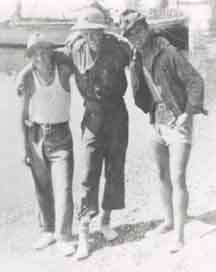
south of the prison camp. Friendly natives made us welcome and a native
Filipino, Ben Aroose, took us nine miles uphill to the house of Mr.
Edwards, a schoolmaster lived in splendid style, like a solitary
sultan. Kelland was immediately smitten by his attractive daughter
 A
month after our arrival, we met up with "Rocky Gause, a pilot who
escaped from Bataan on a small boat, evading the Japs for months. I
don't remember much as I was down with malaria. In his diary, he
mentions he left some rifles with us. There was no way we could all get
in his boat so we decided to remain, the six of us sticking together. I
typed up a letter to my folks on Edward's typewriter and managed to get
it home to my family within the year.
(12) A
month after our arrival, we met up with "Rocky Gause, a pilot who
escaped from Bataan on a small boat, evading the Japs for months. I
don't remember much as I was down with malaria. In his diary, he
mentions he left some rifles with us. There was no way we could all get
in his boat so we decided to remain, the six of us sticking together. I
typed up a letter to my folks on Edward's typewriter and managed to get
it home to my family within the year.
(12)
We remained relatively safe from the Japs. However, the jungle was an
inherently dangerous place. Being on the run from people intent upon
killing you definitely heightens your senses. Walking on a jungle path,
I noticed a branch waving on the trail ahead of me. My sixth sense said
something was wrong as there was no wind. A closer look revealed a
Cobra snake in front of me. My shotgun ended his dance.
Suffering from a severe attack of malaria, I lay sick, flat on my back.
Schoolmaster Edwards took good care of us, giving me quinine to quell
the malaria, ample food and drink. We acquired rifles and a BAR from
weapons hidden by the local constabulary. After three weeks, he
suggested we head south to meet up with some Moros who could help us
get home.
We slipped out past Brooke's Point at dusk, and again, headed south.
Now about 70 miles south of Port Princessa, on the southern edge of San
Antonio Bay, we entered a small river, sailing upstream for about a
mile. The "jungle telegraph" had alerted them to our coming and we were
introduced to Datu Jo Kiple, the head Moro for the area. Datu was a
Muslim who hated the Japanese. His huge home, a mile upstream on the
Tarusan River, housed his twenty seven wives. He was intent on becoming
the Sultan of Jolo Island when the war ended.
The Moslem Moros, in reality pirates, hated the Japanese with a
vengeance. On the third day, a lookout came running into the camp
screaming, "a banca with two men aboard was coming up the river"
Aboard was a Jap Major and a local Mestizo collaborator. I killed the
Jap, tossing his body in the river for the crocodiles. In the pocket of
the collaborator we captured was found a map showing the location of
Datu's hideout. Unfortunately, the Jap's body wasn't tasty enough for
the crocodiles and it drifted into a fish trap downstream. The Japs,
intent upon his capture, placed a large price on Datu's head.
At sundown, Datu returned, beckoned for us and announced he was giving
us two of his best men, Hamja and Lahoud, with instructions to get us
to safety. Datu Jo Kipli spoke excellent English. His sense of humor,
flashing grin, and sincerity impressed us all. "You," he said pointing
to me, "are the youngest…and you have the longest intestines." It
struck me as the funniest description I'd ever heard.
Hamja and Lahoud, stood before us, teeth file flat and blackened with
beetle nut juice. I'm sure they thought our white teeth were ugly.
Armed with guns and knives, they were told simply, "get them through
safely or don't come back." That night, a launch came to the river, its
searchlight seeking the Major's boat. At dark, we took the banca,
paddled downstream and slipped past the Jap launch, raised the sail and
headed north, back to Brook's Point.
October 1942: At Brook's Point, runners were sent to round up the
constabulary that had not surrendered. With the 2 Moros, 15
constabulary and four of us (2 were sick at Edward's house), we decided
to attack the Japs stationed the point. The collaborator told us that
30 Japs were stationed at the school house, across an open field from
the lighthouse. An open ground, 50 yards wide by 100 yards long, lay
between the school and the lighthouse. The schoolhouse had two guard
huts, three feet by four feet, a sloped Atap roof with partial side
cover, completely open on one side. Inside each hut, safely ensconced
from the rain, sat a guard. One shed was on the north side of the
school, the other on the south.
Our men were brought together at 4:00 A.M., the attack being planned
for dawn. The second Jap launch, with a machine on the bow, had
returned at midnight. Sid Wright, carrying the BAR, was assigned the
task of taking out the machine gun. Hamja and I were to take out the
guards.
Just before first light, Hamja and I snuck up behind the huts. I could
see the guard's feet below his seat. I tossed a coconut shell off to
his right front, saw his feet move to the right, rushed around the left
side, reached in a slit his throat. Hamja obviously had similar success.
The plan was to wait, my signal to attack being the sound of a Bob
White whistle. As dawn broke, the Japs filed out of the school, stacked
their rifles and started to form ranks. (Probably for mandatory morning
exercises) I whistled the signal and we attacked. One group of six or
seven Japs fled toward the lighthouse. We could not chase them over the
open ground. Grabbing a launch, they fled for their lives to Puerto
Princesa. The second launch we destroyed, its engine riddled with
bullets. It was a very successful night--we had killed the collaborator
and over20 Jap soldiers.
At Puerto Princesa, the Japs who escaped bragged how they had killed
all of us in a battle. The remaining POWS, discounting the Jap
braggadocio, knew at last that we had successfully escaped. Knowing the
Japs would not return, we decided to stay at Brooke's Point another two
or three weeks. Against my advice, Henderson and Wright went off to a
nearby village. During the night, a collaborator killed Henderson and
Wright shot him dead. When Wright returned, I chewed his butt off but
Henderson was dead…and Kelland remained at Edward's house.
September 1942:
The four of us, Wright, Davis, Hodges, and myself decided to leave for
Balabac, an island 60 miles south of Brooke's Point. Kelland remained
behind with malaria. Joining us were Hamja and Lahoud, my Moro
"Guardians." There we remained for a few weeks before I sent Hamja
south across the Balabac Straits to Kudat, the northern most point of
Borneo. We urgently needed supplies, especially quinine. A Chinese
merchant gave us money but did not want a receipt.
In a square stern 30 foot boat with a rectangular sail, Hamja and his
volunteer crew sailed south. A few days later, he returned bearing the
precious quinine and other surprises. Hamja brought food, Chinese Gin
(orange colored and very potent), whisky, sulfadiazine, and 24 sticks
of dynamite with fuses and detonators With the dynamite came the news
that there were 30 Japs in Kudat, guarding two large oil storage tanks.
I decided we should attack the tanks. In mid October, the four of us
and the 2 Moros, sailed across the open sea to Kudat, arriving before
dawn a few days later. Pulling into a swamp, we covered the boat and
waited until nightfall.
The tanks, 30 feet in diameter, stood 20 feet high. Both were filled
with fuel. Hamja and I killed the sentries, slashing their throats
before they could give an alarm. Dragging the bodies to the tanks, we
lay them aside as we prepared the dynamite and fuses. When all was set,
we weighted the dynamite down with the bodies, lit the fuses and ran
for the boat. The tanks exploded with a roar as we slipped out of the
harbor. The Japs, believing aircraft had bombed the tanks, flashed
searchlights across the sky, desperately searching for the planes. We
sailed back to Balabac, delighted with our success.
We were to remain on Balabac for months, often hearing submarines
passing in the night. We were reluctant to make contact as we were not
sure they were American. In early 1943, Kelland came down from Brooke's
Point to meet us again, bringing with him an Army Captain, Harris, and
his launch.
Via the "Jungle Telegraph," we heard of an American outpost with a
radio on the island of Tawi-Tawi and he was in contact with MacArthur
in Australia.. In August, 1943, our small band of six sailed southeast,
using dead reckoning with only the compass and small map for guidance.
The alarm clock served as a perfect timer for tacking into the wind.
Setting the alarm, we would sail for a fixed time, the alarm would
sound, and we tacked back an equal time the other direction.
We stopped at a Moro fishing village on Cagayan Island. Landing at
night, local Moros informed us the 7 Japs were in a small house on
stilts. The Moros went in, knives slashing, while we fired at anyone
leaving. None survived. Hamja was credited with at least three of the
dead.
We planned to never run out of food. We had stuffed the ballast with
coconuts, giving us a good supplement to rain water. On small scattered
islands, Hamja and Lahoud would probe the sands, pulling up hundreds of
turtle eggs, We used a five gallon can for boiling the eggs. I was
surprised to find the white part never hardened... but they tasted just
fine. Fish were equally plentiful.
On the morning of 10 August, 1943-- after 10 days in the open sea and
exactly one year after our escape, we spotted Bongao Mountain, rising
above the island of Tawi-Tawi. A mere spec in the ocean Tawi-Tawi, was
only 9 by 20 miles. My rudimentary seamanship was sufficient... and
lucky.
On Tawi-Tawi, we met Captain Hamner, 8 or 9 Australians and an American
officer, Lt. Cane, a.k.a., "Sugar Cane." Captain Hamner was in touch
with MacArthur's headquarters in Australia via radio. We took turns
riding a bicycle that drove the generator. Messages had been received
that the Australians and the four of us were to go to Mindanao. We
faced another long voyage across open seas. By this time, one of the
Aussies, Rex Butler, had been killed by a local Moro. We released our
faithful Moros, Himja and Latoud, to return to their home on Palawan.
We all left when around 2 Nov 1943, the Japs landed about 150 soldiers
on the island.
Harris had also escaped from either Bataan or Corregidor. Davis and
Hodges decided it was time to move on and sail for Australia. Taking a
well stocked boat, they departed, disappearing and never to be heard of
again. Just two of our band of escapees remained, Wright and myself.
The first boat leaked so badly, we had to return. Wright, myself, and
the Aussies loaded another boat and headed northeast, past Jolo Island,
skirting along the western tip of Zamboanga Province toward Dipolog.
For seven days, the seas were calm and we rowed continuously, each
taking turns at the tiller. Aussie Major Steele, deciding rowing was
beneath his station as an officer, refused to row. A pistol to his
head, a warning "Row or swim," changed his mind.
In the middle of the night, I was manning the tiller and fell dead
asleep. A sudden lurch from a wave startled me alert. We were smack in
the middle of a blacked out Jap convoy, three ships in front of us and
two behind. No native boats, anywhere in the Philippines, were allowed
out at night. The high pucker factor eased as the convoy slipped by,
steaming out of sight.
Our first landfall was near the town of Siocon on the western coast of
Zamboanga peninsula. A fresh water stream was a welcomed relief as we
washed away the dried sweat, dirt, and salt of the voyage. I got back
into the boat just before a crocodile attacked a local horse. We shot
the crocodile but remained out of the water.
Back on the boat, we continued to row, arriving at Dipolog where a
Filipino Major greeted us. The "Jungle Telegraph" worked perfectly. The
town had electricity and the major maintained a radio. A native
Corpsman served as his assistant. We received orders to report to
Colonel Bowler.
(13) The Major advised us to go over the mountain to Panquil
Bay. Joined by the Major, his wife, and his children, we set out over
Mount Malindang, a 2500 foot climb through a steaming, tangled jungle.
Five days later, skin raw from mosquitoes and leeches, we arrived at
Misanis (?) on the northern shore of Panquil Bay.
January 1944:
In the small village, runners came to say the Japs were coming. The
wind was howling but we had to flee. We climbed aboard a 70 foot boat
with two mast, the outriggers being two foot diameter logs with boards
covering the gap. The skipper refused but the four of us, Sid Wright,
the Aussies Walter Wallace and Jock McClone and myself, made him set
sail.
Shortly after weighing anchor in the morning, the wind flipped this
huge boat over on its back. Native boats came out to rescue us, taking
us to a village on the south shore. Upon landing, we learned a Jap
patrol was headed our way so we fled northward. Fortunately, we had
tied our weapons down but we had lost most of our much needed supplies.
Colonel Furtig, head of the guerillas on Mindanao, had placed Colonel
Bowler in charge of this area. We set out to find Bowler. We
encountered a few stray Jap soldiers and managed to kill them.
Unfortunately, after we passed through Kolambugon, we lost Charlie
Wagner, killed by a Jap patrol near Iligan City.
With the aid of Zapata, a local Mestizo, we took a small motor launch
across the northern coast of Mindanao, arriving at the northeast corner
port of Surigao. We relayed our story of escape and evasion. All the
guerillas were men who decided never to surrender. None had been POWs.
One Aussie, Rex Blow, and Sid Wright, decided to join the guerillas,
Sid receiving a field commission from Furtig.
About 3 March 1944
A few nights later, DeVries, Rook, Benny Lacoto, and I were taken out
to the submarine, the USS Narwhal. Taken below, I
was fed my first real American food in 2 years, showered and settled in
for a voyage home. Our first stop would be Tawi-Tawi where we picked up
a Bill Swift, another marine who had escaped from Palawan.
(14) Captain Hammer and Lt. Cane came out with us on the Narwhal.
As we were offloading ammunition, radar spotted 4 Jap Destroyers and 2
Cruisers bearing down on us. To the blaring ah-ooga of a horn, hatches
were sealed and a crash dive commenced. One Filipino worker was trapped
below and was now part of the crew. Settling on the bottom, the crew
waited in silence. The depth charges started to rain down. Over 200
depth charges blew up around us, blowing fuses, lights and chips of
paint falling like snow.
I began to think I had made a big mistake One charge, failing to
explode, hit the deck and rolled off onto the ocean floor. After what
seemed like hours, sonar declared the Jap ships were gone. On the two
week voyage to Darwin, we sank two freighters with torpedoes and, with
the two deck guns, put another Jap freighter on the bottom.
As we approached Darwin, the skipper, Captain Latta, said, "I heard
you're going to put in for sub duty."
"Sir" I said, "Either you're crazy or someone is lying to you"
Arriving in Australia, I was placed in a hospital under the care of
wonderful nurse. The first one I saw had a nose like a banana... until
I realized it was rather small and cute, unlike the flat noses of
natives, I had grown so accustomed to seeing every day.
Asked if I wanted anything, I said, "Yes A cold beer"
She smiled, left and returned in a few moments with a tall bottle of
cold Australian beer. "Here you go Yank" I was one happy man as I
quaffed that brew.
From Darwin, I was flown to Brisbane aboard a C-47, the military
version of the venerable DC-3. We stopped at a small station along the
way, refueling bodies and the plane. It was not my favorite meal,
mutton and curry but I swilled down the tea with milk. That evening, we
arrived in Brisbane and put up at Mobile Hospital #9. Having spent
almost two years fleeing the Japs, I could not sleep well on the bunk.
It was too soft. I rolled to the deck (floor) and drifted off to sleep.
We had a briefing every morning and afternoon and were free to go
wherever we wanted.
Swift and I were given some Aussie currency and started to explore the
area. Behind the hospital, we found a few horse to rent and headed away
from the hospital. As luck would have it, a found a most delightful pub
with a picnic table in back. Unbeknownst to us, orders had been issued
for us to leave for the states and the military police, MPs and SPs,
were searching the countryside. They found us, the MPS taking the
horses while the Navy boys took us by Jeep back to the hospital.
From Brisbane to Pearl Harbor, we traveled in the luxurious comfort of
the Pan Am China Clipper, a Boeing B-314 Flying Boat, complete with
beds for sleeping. Landing at Palmyra, south of Pearl, I noticed a
young fellow up on the wing doing some maintenance. I turned to my
friend and said, "That looks like my brother" There was no time to
investigate as we were ready to taxi and in moments, were airborne.
When I finally did get home, I learned it was my
him
Arriving in late afternoon at Pearl, we were hustled off and segregated
in a gymnasium. The next morning, we departed aboard a 4 engine Mars
for Alameda. As we boarded in front of a number of high ranking
officers, we were told, "Talk to no one. Say nothing."
An officer, somewhat put out by our treatment, asked, "What's your
rank?"
"Sir. I can't tell you."
He was told to shut up, "We are not to talk to anyone."
With a one day layover in San Francisco, we proceeded direct to
Washington, DC and reported into the Navy Department. At the Federal
Building in San Francisco, I saw Navy women for the first time. Told
they were "Waves," I assumed they were simply employees, working for
the Navy and that they were given some sort of uniform. When told, I
thought, "I must have seemed stupid" Given $500 spending money, Swift
and I went AWOL for three days. When we returned, we were taken to
Admiral Watson, who asked where we were and why we came back. We
answered simply, "We were celebrating and we came back when we ran out
of money."
Although we were treated in many ways as heroes, never once was
consideration given for an award of medals. Officers who had escaped
after we did, not facing a fraction of the dangers we endured, nor
attack and kill Japanese, were awarded Silver Stars, Navy Crosses and
the Medal of Honor. Of the 25,000 prisoners of the Japanese, only 24
managed to ever escape.
After debriefing, we were given money and told to fly back home to
California. Having flown enough... and thinking my luck may not
continue, I asked, "If it's alright with you, I rather take a train.
It's a bit safer."
I finally went home by train.
+ + + + + ++ + ++ +
On the sub were Rook, DeVries and Bernie Lacotta - They
were on the PT Boats that evacuated MacArthur from Corregidor. Each of
these men were given the Silver Star
1. USS Bittern
(AM-36), Div 8, Mine Layer, Lt. T.G. Warfield, Commanding
2. USS Tanager
(AM-5), Div 9, Mine Layer, Lt. Cmdr. Griffrin, Commanding [per Kidd]
3. USS Pigeon
(ASR-6), Sub Sqd 20, Lt R.E. Hawes, Commanding
4. The Japanese
Naval Assault Units were specially selected and trained for assault
tasks, not just as invasion forces. While termed "Japanese Marines" by
the American soldiers, they remained part of the Japanese navy and did
not function like the American marines.
5. Kerr, p 71 Kerr
states that there were "nearly 12,00 men," about 8,700 were Americans,
the balance Filipino. No exact could have been made as the Japanese
disposed of bodies without counting. No official rosters were kept by
American units on Corregidor.
6. What appears as
callous treatment of the POWs was deliberate and served two purposes
for the Japanese. First, it placed pressure on other troops to
surrender. The Japanese told Wainwright the prisoners, now hostages,
would be executed if the other forces on the Philippines did not
surrender. Second, as shown on Guam and Wake, the Japanese deliberately
starved the men for a period to weaken them before and transport. This
assured that a minimum number of guards were needed for the docile
prisoners.
7. Later groups of
prisoners were sent to Cabanatuan #2 but, when conditions proved the
camp unlivable, they too were sent to #3. With the high death rate at
Camp O'Donnell, most of these men were transferred in June to Camp #3.
8. 31 May 1942, p
51, Petak, Joseph A., Never Plan Tomorrow,
Aquataur, Fullerton, 1991. Petak notes the men were from Fort Drum.
William R. Benson, Hugh E. Welman, Fred L. Lee and either Charles B. or
Wesley E. Gordon.
9. If this was the
camp commandant, it would be Lt Col Shigeji Mori, who assumed command
on 26 May.
10. P 91, Haney,
Robert E., Caged Dragons, Sabre Press, Ann Arbor,
1991. Haney notes 4 spectators were detailed by the Japs to cover the
graves. Subsequently, a grave marker was placed that said, "Tell
America, oh passerby, That here obedient to our word we live."
11. Apparently,
Fox was returned to Luzon when the Puerto Princesa detail was reduced
by 150 men later in the war. His name is not among the massacred.
12. P 124, Gause,
Damon "Rocky", The War Journal of Major Damon "Rocky" Gause;
The Firsthand Account of One of the Greatest Escapes of World War II,
Hyperion, New York, 1999. Gause states before he left, three of the
escapees were on the beach with him. He offered to take one as that is
all his boat could handle. "With typical American spirit, all three of
them refused…'We've stuck together through so much that we'll stick
together until the end.'"
13. Escape From
Hell, The Sandakan Story, by Walter Wallace gives a detailed narrative
of this segment of the escape.
14. Corp William
Dewey Swift, USMC, escaped on 2 Feb 1943, along with MM1c Roy Sherman
Pryor, USN, Pvt. Richard Charles Hanson, USA, and Pfc Don Thomson
Schloat, USA. Hanson and Schloat were captured and sent to Manila for
trial. Fate unknown. Pryor, according to Swift, was killed after the
escape.
|