| John Daziel
Black [1917 - 2006] HMS Exeter |
Fukuoka #2 Main British POW Roster
Source: E-mail from
Leading Stoker Black's son, Derek Robertson; 11 Jan 2009
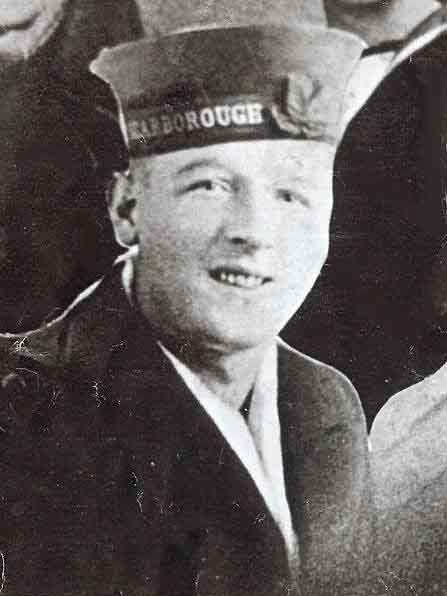 My grandfather was from Airdrie in
Scotland and joined the navy in the late 30's. He was a stoker on the HMS
Exeter when she was sunk and survived incarceration
by the Japanese, dying in 2006 aged 88. My grandfather was from Airdrie in
Scotland and joined the navy in the late 30's. He was a stoker on the HMS
Exeter when she was sunk and survived incarceration
by the Japanese, dying in 2006 aged 88.
Ginger Hair and an Orange By Andrew Black John Dalziel Black came into this world on 23 May 1917. Born in Airdrie, Scotland the fifth child of Alexander and Margaret Black. Eventually they had 16 siblings and his father became the provost of his home town. In the mid thirties John decided to leave the overcrowded house and joined the Royal Navy, marrying Jean Wright, they eventually were parents to five children. John was a leading stoker on HMS Exeter in 1942 when the Exeter and a number of other allied ships were engaged in battle with a Japanese fleet in the Java Sea. The Exeter was sunk and thus began a 3 and a half year period of captivity as a far east prisoner of war. Like many other men who survived that brutal period he spoke very little of his war experiences and subsequent captivity. In 1945 he was in Fukuoka #2 camp near Nagasaki and witnessed the dropping of the ‘A’ bomb by the Americans on the city. These are the stories that have been gathered from the snippets of information that he did relate to the family over the time of his release to his passing away. A span of over 40 years. Consideration must be taken that as in all stories that were never written down at the time of telling the passing of time may have blurred some issues and some facts may be distorted. However, the essence of these recollections are to preserve the memory of a strong-willed, determined, hard working yet very humorous man who fought for his country in her hour of need. One comment on the Exeter was that she had a good captain. Having to spend many months at sea would cause sailors to play games for amusement. One favourite was ‘follow the leader’ if you did not do what the leader did then some form of punishment would befall you. Sometimes they would go into the captain’s quarters when he was asleep and the leader would shout out in a loud voice. Of course the others had to follow up to 12 at a time. The captain would not be amused however the sailors suffered his wrath just for the entertainment value. Once having been ashore and, typically, drinking houses visited one man was so drunk that he was unconscious. They put him in his hammock covering his chest with tomato puree and put a white sheet over him as if he was dead. They got dressed in parade uniform with one rating acting as a priest. After much prompting he awoke, pulled the sheet off his face, saw all the guys with sad faces, the priest, asked what was happening, saw the ‘blood’ on his chest and duly fainted. The Battle of the Java Sea has been well documented, my fathers comments on this was regarding the noise on board the ship when the guns fired and the Japanese shells exploding near the ship. When the ship was hit by an exploding shell the noise was horrendous and in later years this was attributed to his bad hearing. Many may ask why the captain did not go down with the ship, my father explained that the captain, too, had family and it was his wish to see them again. The survivors of the battle were left to cling on to anything that would float and according to my father were some were not picked up, by the Japanese, for three days. The men would encourage each other to “hang on”. One can only assume that this was a very stressful time. Eventually picked out of the seas they crew were taken to Celebes and marched barefoot from one end of the island to the other, on sun-drenched roads and given very little water. Their new horror was just beginning. The prison camp had a “hospital” hut which was just a bare room and no medical equipment. Malaria and dysentery was rife and when men were too sick to work they were thrown into this hut. Some were left to die in these stinking disease ridden huts. My father was put there but managed to survive, how, must be put down to his strong will. After years of abuse men would lose their minds and crawl in a corner to sleep and never wake up. Eventually my father was too weak to carry on and when as part of forced labour working in the shipyard in Nagasaki he too chose his spot to die. He was woken by a Japanese woman forcing an orange into his mouth. This kind and brave act gave him the will to live on. The naval records describe him as having a “fresh” complexion. This was because he had very ginger hair and pale skin. The Japanese were fascinated by this and of course this made him stand out from the crowd. Not a good thing in a very hostile situation. The camp had a box made from corrugated iron where captives were randomly punished by being locked inside during extremely hot days and my father was chosen to suffer this torture. Marching him to his fate he tripped over and fell into some mud which caused his captors great delight to see his ginger hair covered in mud. They laughed so much that it was decided to let him go back to the ranks. The guards would given men a beating for no apparent reason. The Exeter had an officer from Liverpool who stood over 6’5” who would plead with them to leave the men be and to beat him. He survived. After the dropping of the bomb in Hiroshima the prisoners noticed a marked change in the guards and after the Nagasaki bomb they abandoned the camp completely. The prisoners began receiving air drops however the were concerned about what could happen to them and barricaded themselves in the camp. Americans eventually released them from their captivity and he was taken to Hawaii, eventually Vancouver, Canada. A five day train ride across that vast country to Halifax Nova Scotia were he boarded an old French ship to take him to Southampton and eventual reunion with his wife in Glasgow. The round the world took 5 years. John Dalziel Black passed away on Easter Sunday 2006. |